The concept of "data products" has moved from conference buzzword to boardroom mandate. Organizations are no longer satisfied with one-off reports and ad hoc analytics. They want reusable, well-governed, self-describing data assets that can be consumed by multiple teams, applications, and use cases. But building data products requires something most organizations lack: a clear understanding of what data they already have, where it comes from, and how it is transformed.
This is where MigryX Atlas changes the equation. Atlas provides the lineage foundation that data product development requires — automated discovery of existing data flows, column-level transformation mapping, and seamless integration with data catalogs and governance platforms. Instead of building data products from scratch, organizations can use Atlas to discover, document, and modernize the data assets already embedded in their legacy systems.
What Are Data Products and Why Do They Matter?
A data product is a curated, governed, reusable data asset with defined ownership, quality standards, and access controls. Unlike a raw database table or a one-off CSV export, a data product is designed for consumption. It has documentation, a defined schema, SLAs for freshness and quality, and lineage that traces its origin and transformations.
The data product paradigm matters because it solves three persistent organizational problems:
- Duplication. Without data products, multiple teams independently build their own versions of common datasets. The finance team, the risk team, and the marketing team each create their own "customer revenue" table with slightly different logic, producing inconsistent numbers that erode trust in data.
- Discoverability. Data assets are scattered across databases, file systems, cloud storage, and legacy platforms. Analysts spend 30-40% of their time finding and understanding data before they can use it. Data products, registered in a catalog, make data findable and self-describing.
- Governance. Regulatory requirements demand that organizations know where sensitive data resides, who accesses it, and how it is transformed. Data products with embedded lineage and access controls satisfy these requirements by design, rather than through after-the-fact documentation.

MigryX Atlas — Automated column-level data lineage across your entire data estate
The Legacy Discovery Problem
Most organizations have decades of embedded data knowledge locked inside legacy systems. A SAS environment that has been running for 20 years contains thousands of programs that encode business rules, data quality checks, regulatory calculations, and domain-specific transformations. This code represents millions of dollars of accumulated business logic.
When organizations modernize, they face a choice: rebuild everything from scratch on the new platform, or extract and preserve the knowledge from the legacy system. Rebuilding is expensive, risky, and discards institutional knowledge. Extracting requires understanding what the legacy system actually does — at a granular level — and that understanding is what Atlas provides.
Atlas scans the entire legacy estate and produces a complete inventory of data flows, transformation logic, and dependencies. This inventory is the starting point for data product identification: which legacy data flows produce assets that multiple teams consume? Which transformations encode critical business rules that must be preserved? Which outputs feed regulatory reports that require certified lineage?
Legacy systems are not technical debt to be discarded — they are repositories of business logic to be extracted, documented, and modernized. Atlas is the extraction tool.
MigryX Atlas: Lineage That Goes Deeper
While most lineage tools stop at table-level tracking, MigryX Atlas traces every column through every transformation — joins, filters, aggregations, CASE statements, and derived calculations. It automatically generates Source-to-Target Mapping documents (STTMs) that auditors and business analysts can review without reading code. This is not just metadata scanning — it is deep semantic analysis powered by MigryX’s precision AST parsers.
From Legacy Lineage to Data Product Definitions
Atlas lineage provides the raw material for data product development. The process follows a structured path from discovery to publication.
Step 1: Identify Candidate Data Products
Atlas analyzes the dependency graph to find high-value data assets — tables and datasets with many downstream consumers. A staging table that feeds 50 downstream programs across 3 teams is a strong data product candidate. A dataset that is read only by its creator is not. Atlas ranks candidates by consumer count, cross-team usage, and regulatory significance.
Step 2: Extract Transformation Logic
For each candidate data product, Atlas extracts the complete transformation chain — from source data to final output, across all platforms. This chain becomes the data product's lineage documentation and its transformation specification for reimplementation on the target platform.
Step 3: Define Quality Rules
Legacy code often contains implicit data quality checks — WHERE clauses that filter invalid records, conditional logic that handles null values, assertions that validate row counts. Atlas identifies these patterns and surfaces them as explicit data quality rules that can be implemented as automated checks in the modernized pipeline.
Step 4: Publish to Data Catalog
The data product definition — including schema, lineage, transformation logic, quality rules, and ownership — is published to the organization's data catalog. Atlas integrates with the major catalog platforms to automate this step.
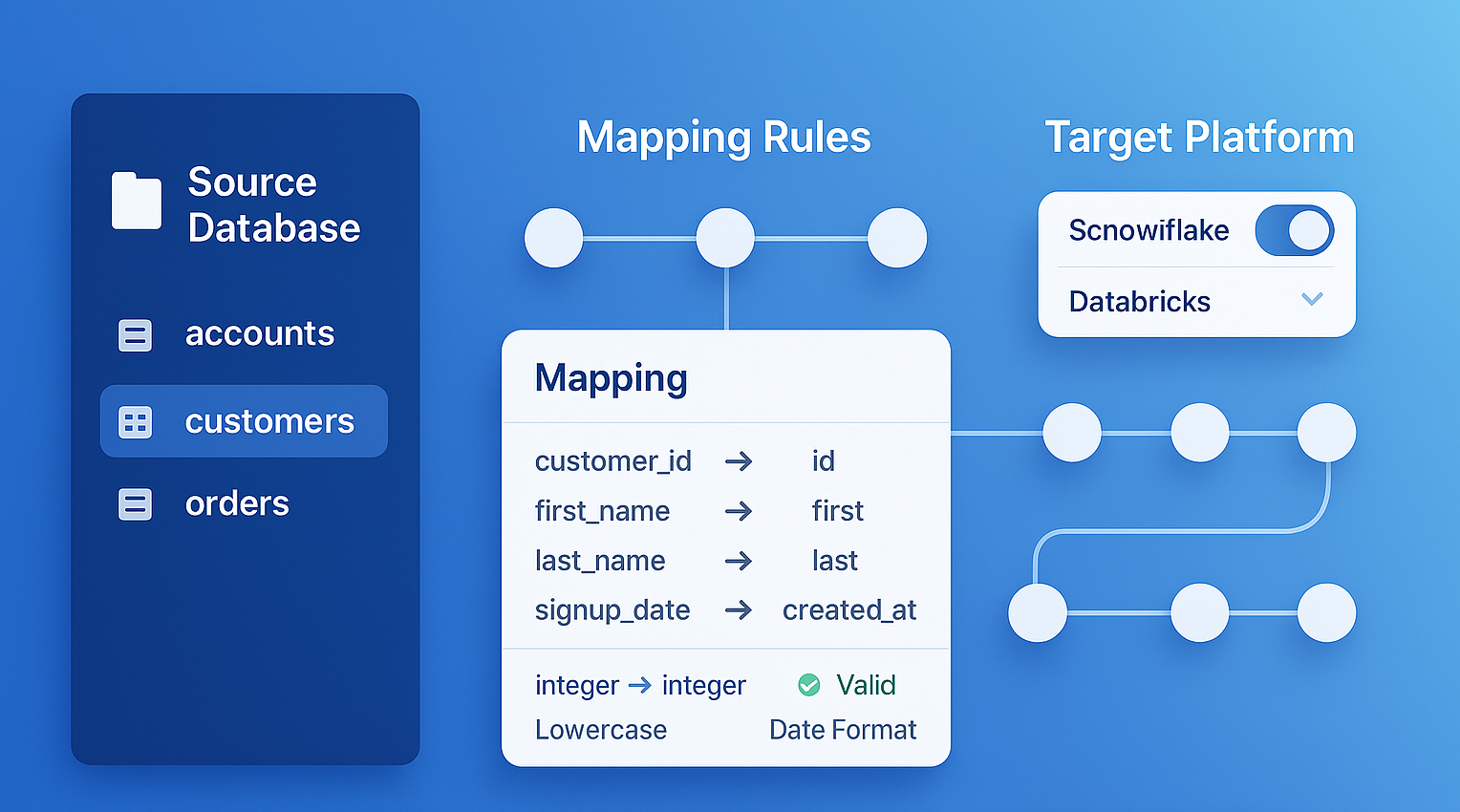
MigryX generates comprehensive Source-to-Target Mappings (STTMs) automatically, eliminating weeks of manual documentation
Why Manual Lineage Documentation Fails — And How MigryX Fixes It
Enterprise data estates contain thousands of interdependent programs. Manual lineage documentation is outdated the moment it is written. MigryX Atlas continuously analyzes your codebase and produces lineage maps that reflect the actual state of your data pipelines — not what someone documented six months ago. Teams using MigryX Atlas report reducing impact analysis time from weeks to hours.
Data Catalog Integration
Atlas lineage becomes most valuable when it flows into the tools that data consumers actually use. Atlas integrates with the leading data catalog and governance platforms.
| Platform | Integration Method | What Atlas Provides |
|---|---|---|
| Collibra | REST API, CSV import | Column-level lineage, transformation rules, source-to-target mappings, data quality rules |
| Alation | REST API, Open Connector | Automated lineage graphs, business glossary enrichment, transformation documentation |
| Atlan | REST API, OpenLineage | Cross-platform lineage, column-level mappings, data product metadata |
| Apache Atlas | REST API, Kafka events | Entity definitions, lineage relationships, classification propagation |
| Custom catalogs | JSON/CSV export | Structured lineage data in standard formats for custom integration |
The integration is not a one-time data load. Atlas continuously updates catalog entries as the codebase evolves, ensuring that catalog lineage stays synchronized with actual data flows. This eliminates the common problem of catalog entries that were accurate when first created but have drifted from reality over time.
Modernization Patterns: Legacy to Cloud-Native
Atlas supports several modernization patterns, each suited to different organizational contexts and risk tolerances.
Lift and shift with lineage preservation. The legacy code is translated to the target platform (e.g., SAS to Python) while Atlas captures and preserves the lineage. The data product definition remains the same; only the implementation changes. This is the lowest-risk approach and maintains full backward compatibility with existing consumers.
Refactor with data product redesign. Atlas lineage reveals opportunities to consolidate multiple legacy programs into a single, well-designed data product. Three SAS programs that each compute slightly different versions of "customer lifetime value" can be refactored into one canonical data product with a single, documented definition. Atlas identifies these consolidation opportunities by analyzing transformation overlap.
Rebuild on modern architecture. For organizations adopting data mesh or data lakehouse architectures, Atlas provides the domain-level lineage needed to decompose monolithic legacy systems into domain-owned data products. Atlas maps which data flows belong to which business domain, enabling teams to take ownership of their data products with full lineage context.
Hybrid modernization. Many organizations cannot migrate everything at once. Atlas supports hybrid architectures where some data products run on legacy platforms and others run on modern platforms, with lineage spanning both. As components are migrated, Atlas updates the lineage graph to reflect the new architecture without losing historical context.
Governance and Compliance in the Modern Stack
Data products built on Atlas lineage inherit governance properties that are difficult to achieve through manual processes.
Automated PII tracking. Atlas traces where personally identifiable information flows through the data estate, from source ingestion to every downstream consumer. When a data product contains PII, Atlas flags every column derived from PII sources, enabling automated classification and access control enforcement.
Regulatory lineage certification. Financial institutions subject to BCBS 239, insurance companies under Solvency II, and healthcare organizations under HIPAA all require certified data lineage for regulatory reports. Atlas-generated lineage provides an auditable, code-derived chain of custody from source to report. Because it is generated from the actual code rather than manually documented, it withstands regulatory scrutiny at a level that spreadsheet-based lineage cannot.
Change governance. When a data product's definition changes — a new column is added, a transformation rule is modified, a source table is replaced — Atlas provides impact analysis showing every consumer that will be affected. This enables data product owners to communicate changes proactively and consumers to prepare for them, replacing the current pattern of surprise-driven data quality incidents.
Key Takeaways
- Data products require lineage as a foundation. Without knowing where data comes from and how it is transformed, you cannot build reusable, governed data assets.
- Atlas discovers data product candidates automatically by analyzing the dependency graph of your legacy estate.
- Legacy business logic is extracted, documented, and preserved — not discarded — during modernization.
- Atlas integrates with Collibra, Alation, Atlan, Apache Atlas, and custom catalogs to publish lineage and data product metadata where consumers need it.
- Multiple modernization patterns (lift-and-shift, refactor, rebuild, hybrid) are supported with continuous lineage tracking.
- Governance, PII tracking, and regulatory compliance are built into the data product lifecycle through automated lineage.
The path from legacy analytics to modern data products does not start with new technology — it starts with understanding what you already have. MigryX Atlas provides that understanding through automated discovery, column-level lineage, and seamless catalog integration. Organizations that build data products on Atlas lineage start with a foundation of complete, accurate, and continuously updated knowledge about their data — the essential prerequisite for every successful modernization initiative.
Why MigryX Is Essential for Data Lineage
The challenges described throughout this article are exactly what MigryX was built to solve. Here is how MigryX transforms this process:
- Column-level precision: MigryX traces data from source field to target column through every transformation step, not just table-to-table connections.
- Automated STTM generation: Source-to-Target Mapping documents are produced automatically, saving weeks of manual effort per migration wave.
- Cross-platform support: MigryX Atlas handles lineage across SAS, Informatica, DataStage, Alteryx, SSIS, and 20+ other technologies in a single unified view.
- Regulatory compliance: SOC 2 compliant audit trails ensure every data flow is documented for regulatory review.
MigryX combines precision AST parsing with Merlin AI to deliver 99% accurate, production-ready migration — turning what used to be a multi-year manual effort into a streamlined, validated process. See it in action.
Start Building Data Products on Atlas
See how Atlas transforms legacy lineage into the foundation for modern, governed data products.
Explore Atlas Schedule a Demo